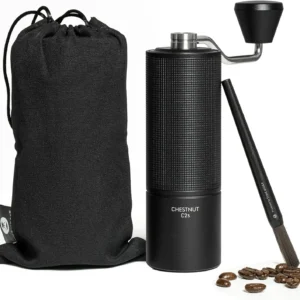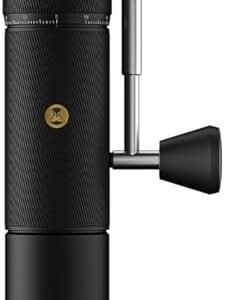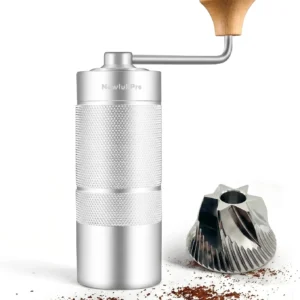
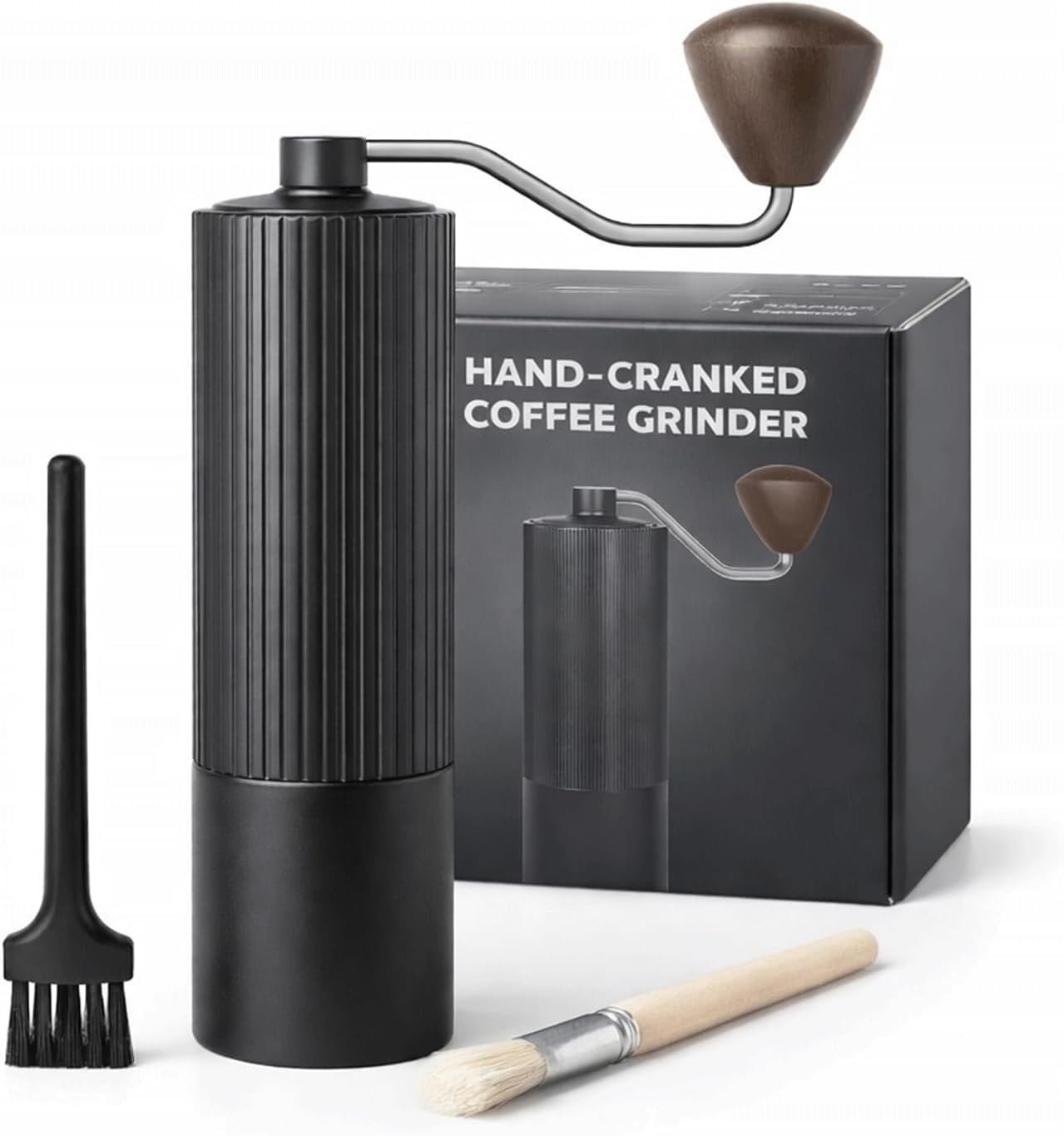
In the crowded landscape of manual coffee grinders, the “Manual Coffee Grinder” positions itself as a compact, portable option. As discerning baristas, we subject every piece of equipment to rigorous technical scrutiny, assessing not just its claims, but its tangible performance in the pursuit of optimal extraction.
Technical Breakdown
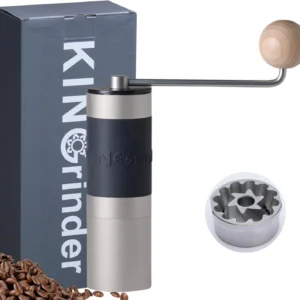
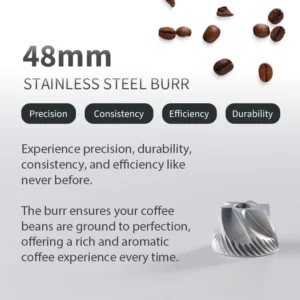
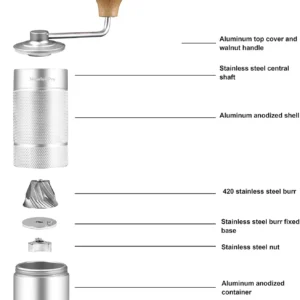
- Burr Material & Design: The grinder features 420-grade stainless steel conical burrs. While 420 SS offers reasonable hardness and corrosion resistance, it is a mid-tier material often exhibiting broader particle distribution compared to higher-alloy tool steels or precision ceramic burrs. The inherent design of conical burrs is conducive to less fines production than flat burrs, though the specific geometry here is undisclosed.
- Body & Internal Construction: An aluminum alloy body provides a rigid housing for the grinding mechanism, crucial for stability and minimizing flex during operation. The internal components, including presumably the burr shaft, are stated to be stainless steel, which is standard for durability and rust prevention in coffee environments.
- Handle & Ergonomics: A walnut wood handle is aesthetically pleasing and offers a comfortable grip. The emphasis on “smooth rotation” implies adequate bearing support, though the number or type of bearings is not specified, which directly impacts wobble and grind consistency, particularly at finer settings.
- Grind Adjustment Mechanism: This is a critical point of technical evaluation. The unit states “2–3 adjustable grind settings.” For any serious coffee enthusiast, let alone a professional barista, this is an extraordinarily limited range. Espresso, Turkish, and French Press each demand distinct, precise particle sizes, and a 2-3 step adjustment system offers virtually no granular control over the required micro-adjustments for perfect extraction across varying beans and roast levels. This severely curtails its utility for anything beyond very coarse or very fine without true intermediate steps.
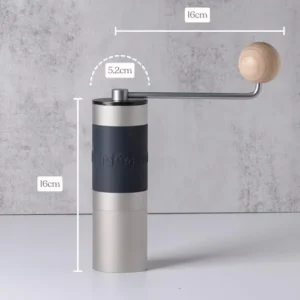
- Capacity & Dimensions: With a 30g bean capacity, this grinder is explicitly designed for single-serve applications. Its compact form factor (17.8 cm height, 5 cm diameter) prioritizes portability, which can sometimes compromise stability during aggressive grinding for fine settings.
The Real-world Performance
Given the severely restricted 2-3 grind settings, achieving optimal flavor extraction or consistent crema for espresso is a statistical improbability rather than a reliable outcome. The burr material, while adequate, coupled with this lack of adjustability, will inevitably lead to a broad particle distribution at any given setting, resulting in uneven extraction and a muted, potentially bitter or sour cup. Temperature stability is less of a concern for a manual grinder of this capacity, but the inability to dial in the grind precisely means any efforts toward thermal consistency in brewing will be undermined by inconsistent grounds.
Who is this for?
This grinder is suited for the occasional traveler or a highly casual user prioritizing portability over precise coffee extraction parameters.
Data Breakdown
| Specification | Detail |
|---|---|
| Burr Material | 420 Stainless Steel |
| Body Material | Aluminum Alloy |
| Grind Settings | 2-3 Adjustable Steps |
| Bean Capacity | 30 grams |
| Dimensions (H x D) | 17.8 cm x 5 cm (approx. 6.69″ x 2″) |
| Handle Material | Walnut Wood |


![COLETTI Crag Manual Coffee Grinder — Hand Coffee Grinder — CNC Burr Precision Hand Grind, Heavy Duty for Travel, Camping, Hiking & Adventure – Includes Brush [Black Coat]](https://baristamanual.com/wp-content/uploads/2026/07/coletti-crag-manual-coffee-grinder-hand-coffee-grinder-cnc-burr-precision-hand-grind-heavy-duty-for-travel-camping-hiking-amp-adventure-includes-brush-black-coat-featured-image-300x300.webp)
![COLETTI Crag Manual Coffee Grinder — Hand Coffee Grinder — CNC Burr Precision Hand Grind, Heavy Duty for Travel, Camping, Hiking & Adventure – Includes Brush [Black Coat] view 1](https://baristamanual.com/wp-content/uploads/2026/07/coletti-crag-manual-coffee-grinder-hand-coffee-grinder-cnc-burr-precision-hand-grind-heavy-duty-for-travel-camping-hiking-amp-adventure-includes-brush-black-coat-detail-image-1-300x300.webp)