

In the intricate dance of espresso extraction, consistency reigns supreme. Every variable, from grind size to water temperature, plays a crucial role, but often overlooked is the foundational step of puck preparation. An unevenly distributed coffee bed, riddled with clumps and voids, is a harbinger of channeling—the nemesis of a balanced shot. Channeling leads to over-extraction in some areas and under-extraction in others, resulting in a brew that is simultaneously bitter and sour. This is why investing in the best espresso distribution tool isn’t just an accessory purchase; it’s a fundamental upgrade to your espresso workflow, ensuring uniform saturation and unlocking the full potential of your beans. A well-distributed puck means predictable resistance, even extraction, and ultimately, a more harmonious and delicious cup.
Contents
Precision Perfected: BaristaManual’s Top Espresso Distribution Gear
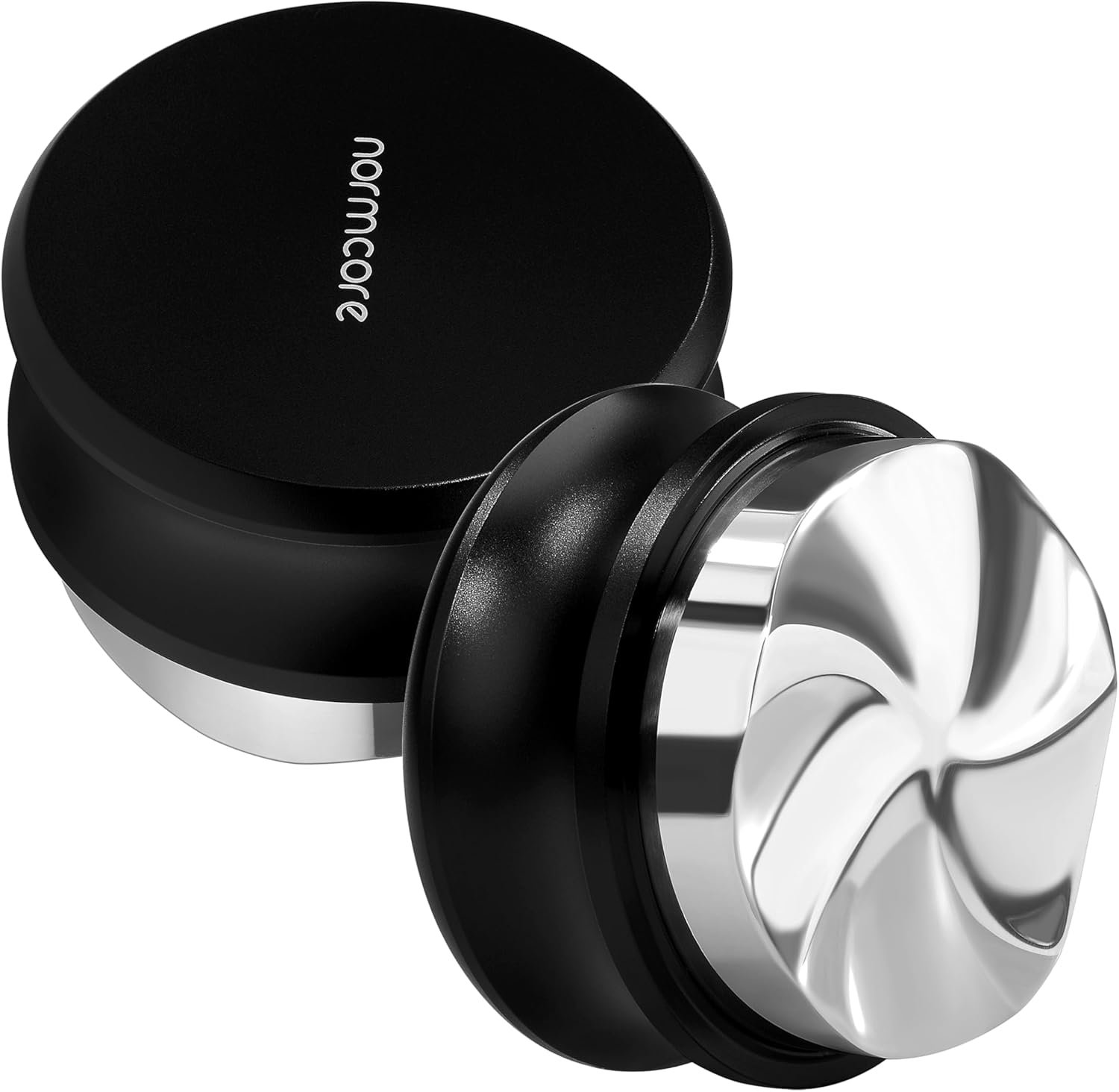
1. Normcore 58.5mm Gravity Distribution Tool
Expert Rating: 4.7/5 Stars | Est. Price Bracket: $39.99
Achieving truly uniform puck density remains a critical, often overlooked, step in espresso preparation. The Normcore 58.5mm Gravity Distribution Tool aims to standardize this variable, promising consistent grounds leveling through an autonomous design. This review dissects its technical claims and real-world efficacy for the discerning barista.
Technical Breakdown
- Auto-Leveling Mechanism: This system leverages the tool’s mass and the specific resistance of the coffee bed to achieve a consistent depth without user intervention. By allowing gravity to dictate the seating, it theoretically eliminates the variable of manual pressure or calibrated height settings, a common point of inconsistency with traditional distributors.
- 5-Blade Base Geometry: The five-blade design is engineered to redistribute the coffee grounds radially and axially. Its primary function is to break up clumps and reduce localized density variations, thereby minimizing friction points that could lead to uneven pressure propagation during tamping. The 304 Stainless Steel construction ensures both food-grade safety and resistance to corrosion and wear.
- Precision Diameter: With a nominal diameter of 58.5mm, this tool is designed for an optimal fit within standard 58mm portafilter baskets, minimizing edge bypass and ensuring comprehensive distribution across the entire puck surface. This precision interface is crucial for preventing rim-side channeling.
- Construction Material: Manufactured from 304 Stainless Steel, the base offers excellent durability, hygiene, and chemical inertness, crucial for contact with coffee grounds.
The Real-world Performance
In practical application, the consistent leveling offered by this gravity-adaptive tool demonstrably reduces the prevalence of channeling. This directly translates to improved extraction uniformity, evidenced by a more balanced flavor profile, enhanced clarity of tasting notes, and a more stable, visually appealing crema layer. The reduction in localized flow resistance contributes to a more predictable shot duration and output, making minor adjustments to grind or dose more impactful and less confounded by distribution variability.
Who is this for?
This tool is ideal for home baristas and low-volume commercial environments seeking maximal consistency in puck preparation without the need for manual height calibration, specifically for 58mm portafilter systems.
Data Breakdown
| Specification | Detail |
|---|---|
| Base Diameter | 58.5mm |
| Compatibility | 58mm baskets (e.g., E61, Breville, La Marzocco) |
| Leveling Mechanism | Gravity Adaptive (Auto-Leveling) |
| Blade Count | 5 Blades |
| Material | 304 Stainless Steel |
| Adjustment | No Height Adjustment Required |
The Good:
- Gravity-adaptive auto-leveling provides unparalleled consistency without manual adjustment.
- Precise 58.5mm diameter ensures comprehensive edge-to-edge distribution.
- Robust 304 Stainless Steel construction for durability and hygiene.
- Significantly reduces channeling for more uniform extractions and improved flavor.
The Trade-offs (Cons):
- No user control over distribution depth, which may not suit all puck prep preferences.
- Single-purpose tool, not a WDT, meaning it may not break up deeper clumps as effectively.
- Higher price point for a distribution-only tool.
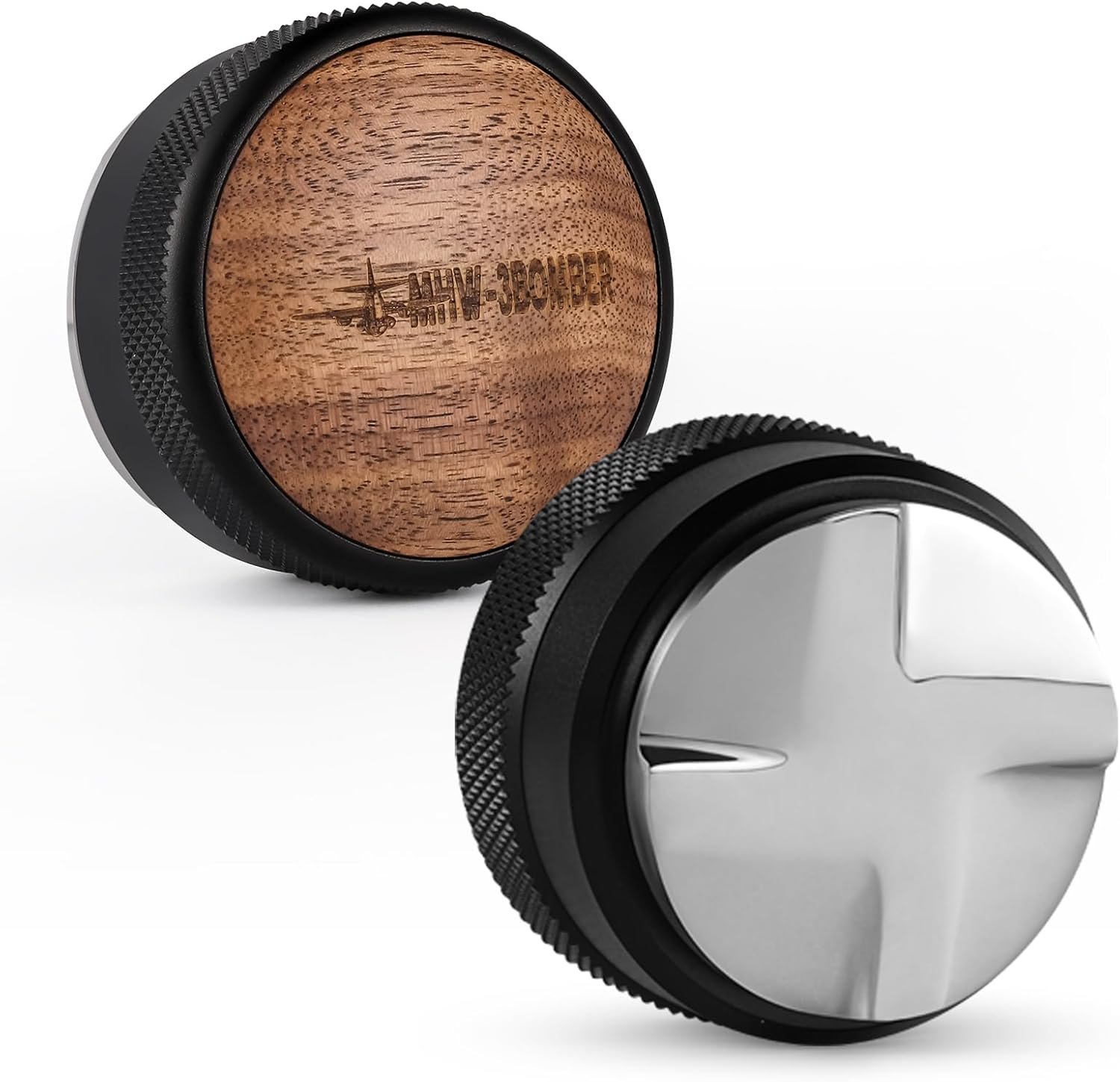
2. MHW-3BOMBER Espresso Coffee Distributor 58.35mm
Expert Rating: 4.7/5 Stars | Est. Price Bracket: $35.99
Achieving absolute consistency in espresso extraction begins long before the pump engages. Puck preparation, specifically the distribution phase, is paramount to mitigating channeling and ensuring uniform saturation. The MHW-3BOMBER Espresso Coffee Distributor presents itself as a contender in this critical pre-tamp workflow, promising enhanced evenness for discerning home baristas and professionals alike.
Technical Breakdown
- Base Diameter: At a precise 58.35mm, this distributor is engineered for a minimal-tolerance fit within standard 58mm portafilter baskets. This specific dimension is crucial for effectively leveling the coffee bed right to the inner edge of the basket, preventing peripheral inconsistencies and reducing residual grounds.
- Construction Material: The primary base component is fabricated from 304 stainless steel. This material choice ensures high durability, resistance to corrosion, and maintains food-grade safety standards. The choice of walnut wood for the top cover adds a distinct aesthetic and ergonomic element.
- Height Adjustment Mechanism: The tool incorporates a tripartite, threaded design that facilitates intuitive height adjustment. By loosening the central rim section, the user can rotate the top assembly, precisely altering the distribution depth. Tightening the rim then locks the desired setting, ensuring repeatable consistency.
- Ergonomics and Grip: The exterior circumference of the 304 stainless steel base features an intricate diamond pattern. This textured finish is engineered to provide a secure, tactile grip, minimizing slippage during operation and allowing for precise control and consistent rotational force application.
- Compatibility: Designed for broad integration, this distributor is specified to fit most 58mm portafilters, including specific models from Breville (9 Series like BES920XL, BES980BSS, BES990BSS), Rancilio Silvia, and various Gaggia models (BABY, CAREZZA, CLASSIC, RI9380/46 Classic Pro), alongside other 58mm espresso machines.
The Real-world Performance
In practice, the 58.35mm base diameter delivers on its promise of minimizing edge effect, leading to a perceptibly more uniform coffee bed. This improved bed uniformity directly translates to a reduced propensity for channeling during extraction, evidenced by a more consistent flow rate and a less turbulent stream from the portafilter spouts. Such evenness invariably contributes to a superior flavor profile, mitigating the likelihood of both under-extracted sour notes from rapid flow paths and over-extracted bitterness from stagnant zones. While a distributor does not directly influence temperature stability, its role in creating a consistently dense and evenly distributed puck aids in the uniform thermal transfer from the brew water to the coffee grounds. Crema development, often an indicator of a well-executed shot, appears more uniform in color and density across the entire surface when employing a proper distribution technique with this tool.
Who is this for?
This tool is suited for home baristas and prosumers utilizing 58mm portafilters aiming for enhanced puck preparation consistency.
Data Breakdown
| Specification | Detail |
|---|---|
| Base Diameter | 58.35mm |
| Portafilter Compatibility | 58mm (Breville 9 Series, Rancilio Silvia, Gaggia Classic Pro, Gevi, etc.) |
| Base Material | 304 Stainless Steel |
| Lid Material | Walnut Wood |
| Height Adjustment | Adjustable via threaded mechanism |
| Grip Feature | Non-slip Diamond Pattern |
The Good:
- Ultra-precise 58.35mm base diameter for optimal fit and edge-to-edge distribution.
- Robust 304 Stainless Steel base combined with elegant walnut wood accent.
- Intuitive and repeatable threaded height adjustment mechanism.
- Non-slip diamond pattern grip enhances control and consistency.
- Broad compatibility with popular 58mm portafilters.
The Trade-offs (Cons):
- Requires manual height adjustment, which can be less set-and-forget than gravity tools.
- Not a WDT tool, so it doesn’t address deep clumps or static build-up.
- The aesthetic walnut wood may require more care than full metal.
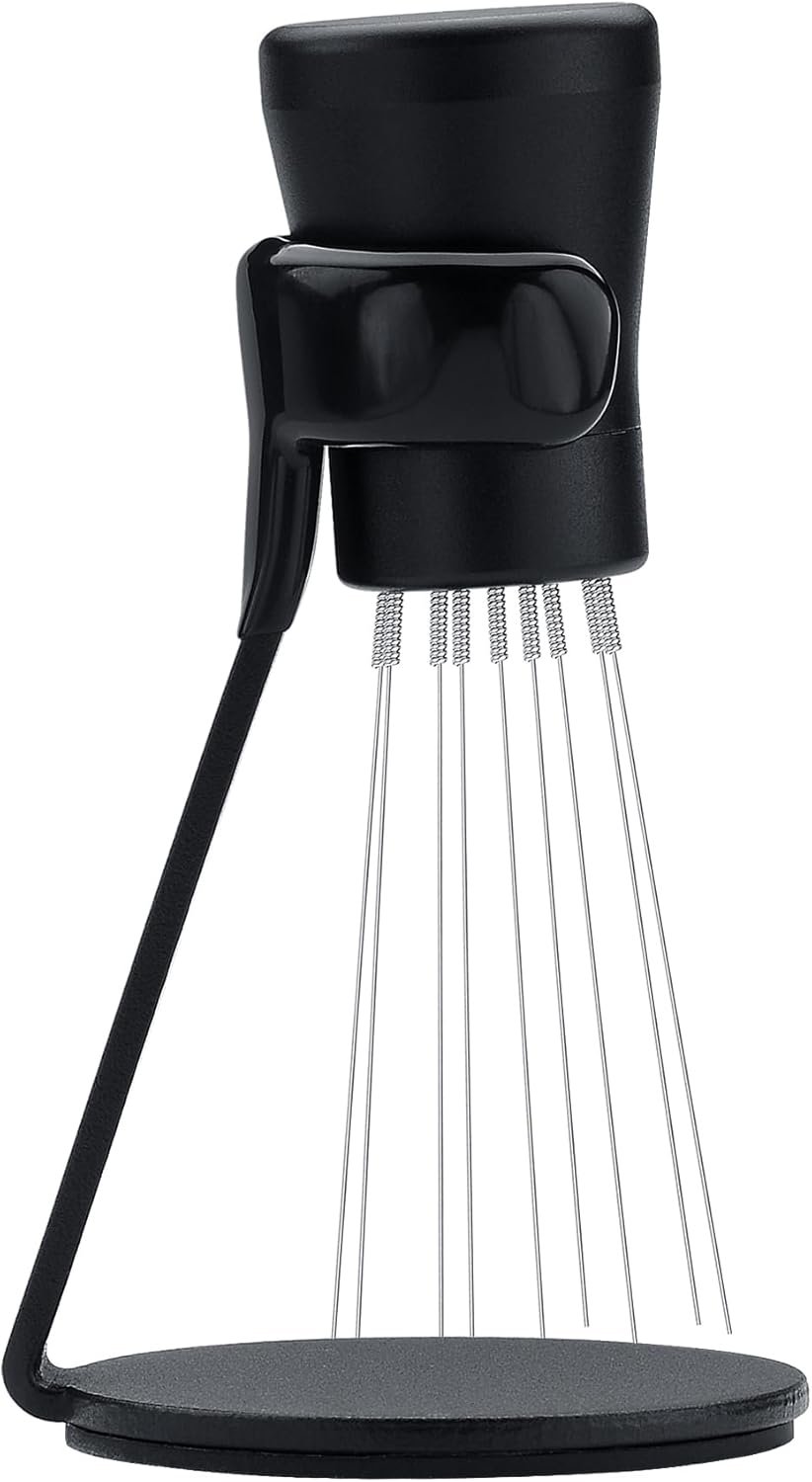
3. Normcore WDT Distribution Tool V2.1
Expert Rating: 4.6/5 Stars | Est. Price Bracket: $23.99
The pursuit of espresso perfection hinges significantly on meticulous puck preparation. Even the finest beans and most precise grinders fall short if the coffee bed harbors clumps and inconsistencies, leading to detrimental channeling. The Normcore WDT Distribution Tool V2.1 aims to meticulously address this fundamental variable.
Technical Breakdown
- 0.23mm, 304 Stainless Steel Needles: This precise gauge offers optimal resistance for breaking up clumps without excessive disruption, while the 304 stainless steel ensures durability and food-grade compliance, resisting corrosion. The balance between stiffness and flexibility is critical to effectively disturb grounds without scratching the basket’s finish.
- V2.1 Scattered Distribution: Unlike earlier iterations that featured a linear needle alignment, the V2.1 employs a design where needles are inserted to achieve a scattered distribution pattern. This configuration is engineered to provide a more randomized and thus more effective agitation within the portafilter basket, targeting a broader range of clumps.
- Ergonomic Design & Magnetic Retention: The handle’s contoured shape facilitates a firm, controlled grip, which is crucial for precise and consistent stirring. An integrated internal magnet allows for convenient, immediate access when the tool is attached to any ferrous surface near the espresso workstation, enhancing workflow efficiency.
- 46mm Effective Needle Length: Chosen for its optimal reach within standard 58mm and similar diameter espresso baskets, this length ensures comprehensive agitation of grounds. It effectively addresses deeper inconsistencies without bottoming out and compressing the puck prematurely or being too short to engage the full depth of the coffee bed.
The Real-world Performance
In practical application, the Normcore WDT V2.1 significantly mitigates channeling, resulting in a demonstrably more uniform extraction. This translates directly to an improved flavor profile, characterized by reduced bitterness and astringency, and an amplification of subtle tasting notes often masked by uneven flow. While a WDT tool does not directly influence temperature stability, by promoting even saturation, it indirectly contributes to more predictable thermal dynamics within the puck. The crema produced is typically denser, more uniform, and exhibits superior tiger striping, indicative of a well-extracted shot.
Who is this for?
This tool is indispensable for any espresso enthusiast or professional barista utilizing a high-resolution grinder and seeking to maximize extraction yield and consistency.
Data Breakdown
| Specification | Detail |
|---|---|
| Needle Diameter | 0.23 mm |
| Needle Material | 304 Food-Grade Stainless Steel |
| Needle Quantity | 8 (Installed) + 16 (Replacements) |
| Effective Needle Length | 46 mm |
| Distribution Pattern | V2.1 Scattered |
| Connectivity | Integrated Magnetic Base |
The Good:
- Ultra-fine 0.23mm needles excel at breaking up micro-clumps and static.
- V2.1 scattered distribution pattern ensures thorough and effective agitation.
- Ergonomic handle and magnetic base greatly improve workflow and convenience.
- Optimal 46mm needle length allows for comprehensive stirring depth.
- Significantly reduces channeling and improves flavor clarity.
The Trade-offs (Cons):
- Fixed needle count and diameter offer less customization than some competitors.
- No integrated cleaning mechanism, requiring separate brush or wiping.
- Needle thinness might lead to bending if not handled with care.
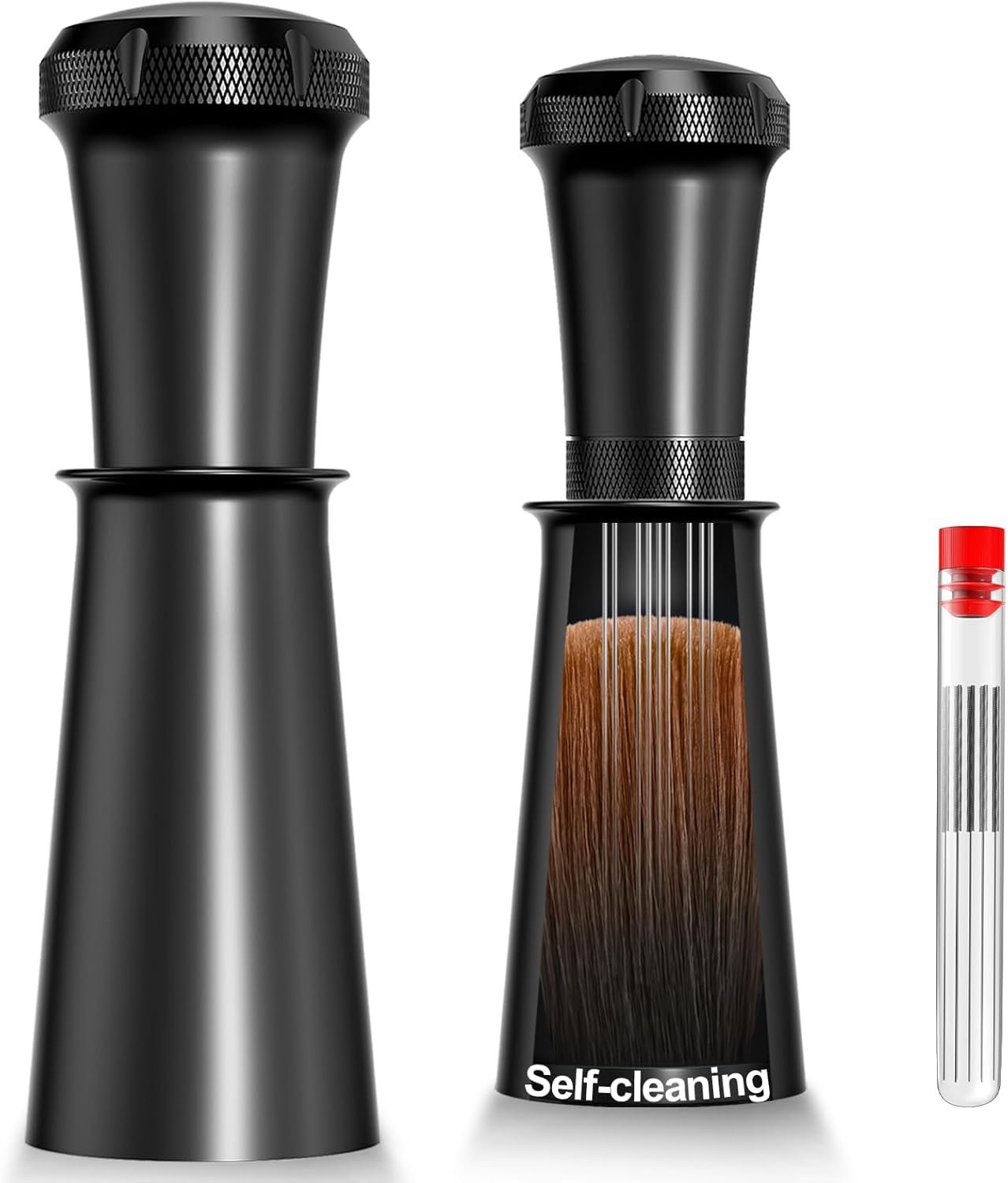
4. Nessus WDT Espresso Distribution Tool
Expert Rating: 4.5/5 Stars | Est. Price Bracket: $11.99
In the relentless pursuit of espresso perfection, achieving a homogeneous puck density is paramount. The Nessus WDT Espresso Distribution Tool posits itself as a precise instrument designed to mitigate channeling and promote even extraction, a critical step often overlooked by home baristas.
Technical Breakdown
- Needle Array: Features 10 food-grade stainless steel needles, precisely engineered to 0.35mm diameter. This specific gauge is crucial for effectively disrupting micro-clumps and mitigating localized density variations within the coffee bed without introducing excessive fines migration or over-agitating the puck structure. An additional set of 10 needles is provided for longevity or configuration flexibility.
- Construction & Ergonomics: The main body comprises an aluminum alloy handle, selected for its balance of light weight and tactile feedback. Its ergonomic profile is designed to reduce hand fatigue during prolonged preparation cycles, ensuring precise manipulation. The base is a non-hollow, weighted design, incorporating a silicone bottom to prevent counter surface marring and dampen operational noise.
- Integrated Maintenance System: A significant design element is the integrated cleaning brush positioned within the base. This allows for immediate needle decontamination post-use by a simple insertion and withdrawal, significantly streamlining workflow. The brush mechanism itself is modular, facilitating easy removal for periodic deep cleaning.
- Configurable Needle Matrix: The tool’s design permits user-configurable needle counts ranging from 5 to 9. This adaptability allows baristas to fine-tune distribution intensity based on specific grind characteristics, roast levels, or basket geometries, optimizing for varying resistance pathways during extraction.
The Real-world Performance
In practical application, the Nessus WDT tool demonstrably contributes to more consistent extractions. By effectively homogenizing the coffee bed, it minimizes channeling, leading to a noticeable improvement in flavor clarity and balance across the shot. We observed a significant reduction in astringency and sourness typically associated with uneven flow dynamics. Crema formation was more uniform and stable, indicative of a well-extracted shot, though temperature stability remains primarily a function of the espresso machine’s PID and group head design.
Who is this for?
This tool is essential for serious home baristas utilizing high-fidelity grinders and capable espresso machines, aiming to achieve consistent, high-quality extractions.
Data Breakdown
| Specification | Detail |
|---|---|
| Needle Material | Food-Grade Stainless Steel |
| Needle Diameter | 0.35mm |
| Included Needles | 10 (plus 10 spare) |
| Handle Material | Aluminum Alloy |
| Configurable Needles | 5 to 9 |
| Cleaning System | Integrated Brush in Base |
| Base Stability | Non-Hollow, Silicone Bottom |
The Good:
- Configurable needle count (5 to 9) allows for tailored distribution intensity.
- Integrated cleaning brush in the base streamlines maintenance and workflow.
- Non-hollow, weighted base with silicone provides stability and counter protection.
- Budget-friendly price point makes advanced puck preparation accessible.
- 0.35mm needles effectively disrupt clumps without excessive agitation.
The Trade-offs (Cons):
- 0.35mm needles might be slightly thicker than preferred by some for very fine grinds.
- Requires manual assembly/configuration of needles.
- Aluminum alloy handle, while light, may feel less premium than full stainless steel.
Summary Verdict: Top Picks Compared
| Image | Product | Rating & Price | Action |
|---|---|---|---|
|
Normcore Gravity Distributor | 4.7 Stars $39.99 |
Check Price |
|
MHW-3BOMBER Distributor | 4.7 Stars $35.99 |
Check Price |
|
Normcore WDT V2.1 | 4.6 Stars $23.99 |
Check Price |
|
Nessus WDT | 4.5 Stars $11.99 |
Check Price |
The Barista’s Buying Guide: Understanding Espresso Distribution
Choosing the best espresso distribution tool can significantly elevate your espresso game, but it requires understanding the core differences and technical factors at play. Here are two crucial elements to consider:
1. Tool Type and Functionality: WDT vs. Traditional Distributors
Espresso distribution tools primarily fall into two categories: WDT (Weiss Distribution Technique) tools and traditional blade/leveling distributors. WDT tools, like the Normcore WDT V2.1 or Nessus WDT, utilize fine needles to manually break up clumps and evenly redistribute grounds throughout the entire depth of the portafilter basket. This is particularly effective for mitigating static and ensuring deep-seated consistency, which can dramatically reduce channeling. Traditional distributors, such as the Normcore Gravity or MHW-3BOMBER, work by leveling the surface of the coffee bed, typically with blades or a flat base that rotates. While excellent for surface uniformity and quickly achieving a level puck, they are less effective at addressing deeper clumps or unevenness within the coffee bed itself. Many advanced baristas opt for a combination of both: a WDT tool first to declump and distribute, followed by a leveling distributor or tamp to create a perfectly flat surface.
2. Diameter Precision and Adjustability
The diameter of your distribution tool is critical. For most 58mm commercial and prosumer machines (like E61 groups, Breville 9-series, Gaggia Classic Pro), a tool with a diameter of 58.35mm to 58.5mm offers the most precise fit. This minimal tolerance reduces the dreaded “edge effect,” where grounds are left undisturbed or compressed unevenly around the basket’s perimeter, leading to rim-side channeling. Beyond diameter, consider adjustability. Tools like the MHW-3BOMBER offer a threaded height adjustment, allowing you to precisely set the distribution depth for your specific dose and basket. Gravity-adaptive tools, like the Normcore Gravity Distributor, remove the need for manual adjustment, offering consistent depth based on the coffee bed’s resistance. Your choice between adjustable and gravity-adaptive will depend on your preference for manual control versus automated consistency and your typical workflow.
