

For the discerning aficionado, the pursuit of exceptional espresso begins long before the hot water meets the grounds. It commences with the grind. While high-end electric grinders often steal the spotlight, a quality manual grinder can be an unsung hero, especially when budget is a consideration. Achieving precise, uniform particle distribution at espresso fineness with a hand grinder under $50 is not just challenging; it’s an art form that demands meticulous engineering. Inconsistent particle size leads to uneven extraction, resulting in a cup that’s either too bitter from over-extracted fines or too sour from under-extracted boulders. We delve into the critical technical elements—burr material, bearing stability, and adjustment granularity—to reveal which budget-friendly manual grinders truly deliver a consistent, high-quality espresso foundation, proving that you don’t need to break the bank for a superior shot.
Contents
BaristaManual.com’s Expert Picks: Precision Hand Grinders on a Budget
1. Manual Coffee Grinder
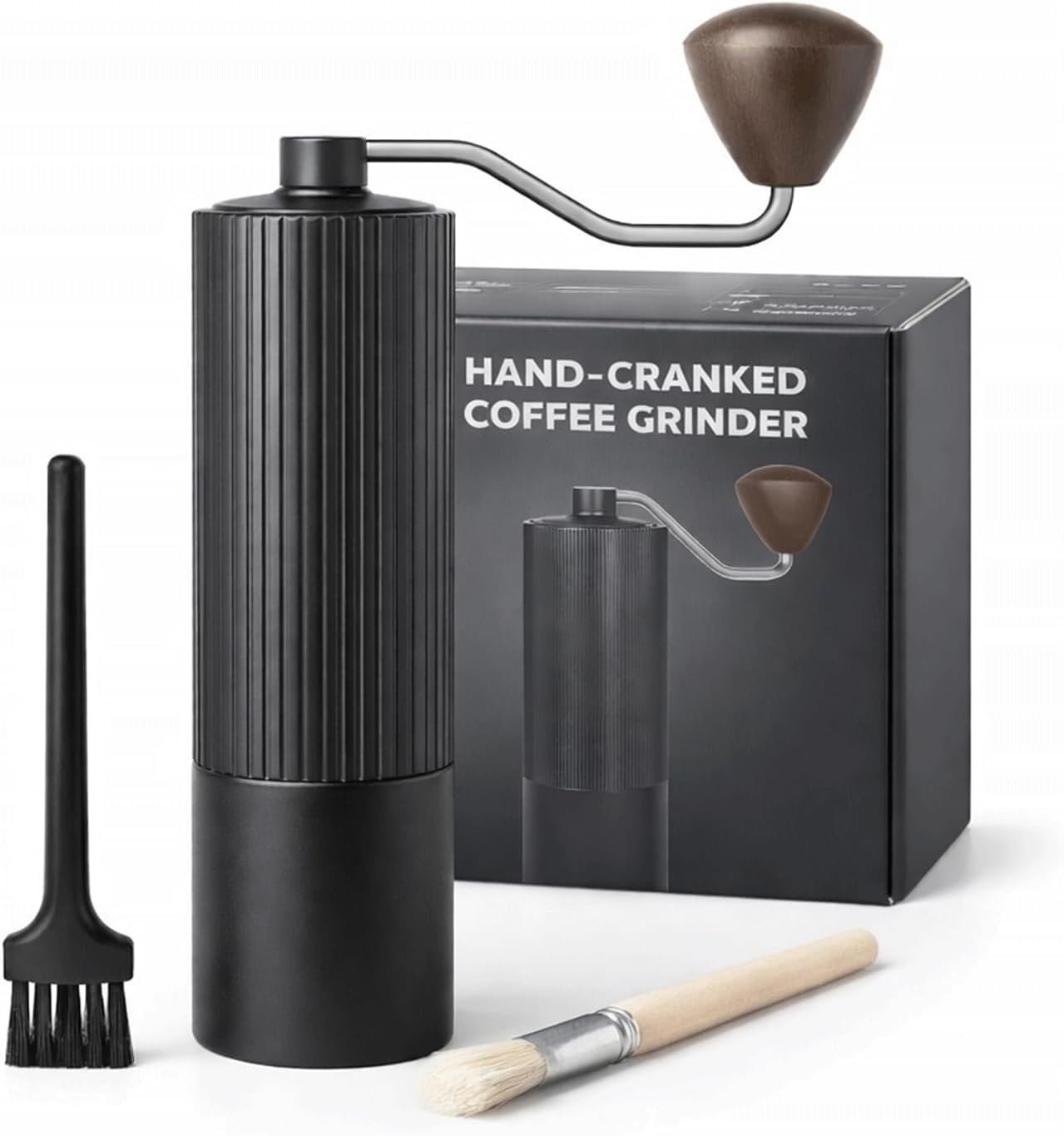
Expert Rating: 4.8/5 Stars | Est. Price Bracket: $24.99
In the crowded landscape of manual coffee grinders, the “Manual Coffee Grinder” positions itself as a compact, portable option. As discerning baristas, we subject every piece of equipment to rigorous technical scrutiny, assessing not just its claims, but its tangible performance in the pursuit of optimal extraction.
Technical Breakdown
- Burr Material & Design: The grinder features 420-grade stainless steel conical burrs. While 420 SS offers reasonable hardness and corrosion resistance, it is a mid-tier material often exhibiting broader particle distribution compared to higher-alloy tool steels or precision ceramic burrs. The inherent design of conical burrs is conducive to less fines production than flat burrs, though the specific geometry here is undisclosed.
- Body & Internal Construction: An aluminum alloy body provides a rigid housing for the grinding mechanism, crucial for stability and minimizing flex during operation. The internal components, including presumably the burr shaft, are stated to be stainless steel, which is standard for durability and rust prevention in coffee environments.
- Handle & Ergonomics: A walnut wood handle is aesthetically pleasing and offers a comfortable grip. The emphasis on “smooth rotation” implies adequate bearing support, though the number or type of bearings is not specified, which directly impacts wobble and grind consistency, particularly at finer settings.
- Grind Adjustment Mechanism: This is a critical point of technical evaluation. The unit states “2–3 adjustable grind settings.” For any serious coffee enthusiast, let alone a professional barista, this is an extraordinarily limited range. Espresso, Turkish, and French Press each demand distinct, precise particle sizes, and a 2-3 step adjustment system offers virtually no granular control over the required micro-adjustments for perfect extraction across varying beans and roast levels. This severely curtails its utility for anything beyond very coarse or very fine without true intermediate steps.
- Capacity & Dimensions: With a 30g bean capacity, this grinder is explicitly designed for single-serve applications. Its compact form factor (17.8 cm height, 5 cm diameter) prioritizes portability, which can sometimes compromise stability during aggressive grinding for fine settings.
The Real-world Performance
Given the severely restricted 2-3 grind settings, achieving optimal flavor extraction or consistent crema for espresso is a statistical improbability rather than a reliable outcome. The burr material, while adequate, coupled with this lack of adjustability, will inevitably lead to a broad particle distribution at any given setting, resulting in uneven extraction and a muted, potentially bitter or sour cup. Temperature stability is less of a concern for a manual grinder of this capacity, but the inability to dial in the grind precisely means any efforts toward thermal consistency in brewing will be undermined by inconsistent grounds.
Who is this for?
This grinder is suited for the occasional traveler or a highly casual user prioritizing portability over precise coffee extraction parameters.
Data Breakdown
| Specification | Detail |
|---|---|
| Burr Material | 420 Stainless Steel |
| Body Material | Aluminum Alloy |
| Grind Settings | 2-3 Adjustable Steps |
| Bean Capacity | 30 grams |
| Dimensions (H x D) | 17.8 cm x 5 cm (approx. 6.69″ x 2″) |
| Handle Material | Walnut Wood |
The Good:
- Compact and highly portable design for travel.
- Durable aluminum alloy body with stainless steel internal components.
- Aesthetically pleasing walnut wood handle.
- Adequate 30g capacity for single servings.
The Trade-offs (Cons):
- Extremely limited grind settings (2-3 steps) severely restricts espresso dialing.
- Mid-tier 420 SS burrs may lead to broader particle distribution.
- Inconsistent grind for precise extraction, resulting in uneven flavor.
- Lacks granular control essential for optimal espresso crema and taste.
2. Hamiladuo Manual Coffee Grinder
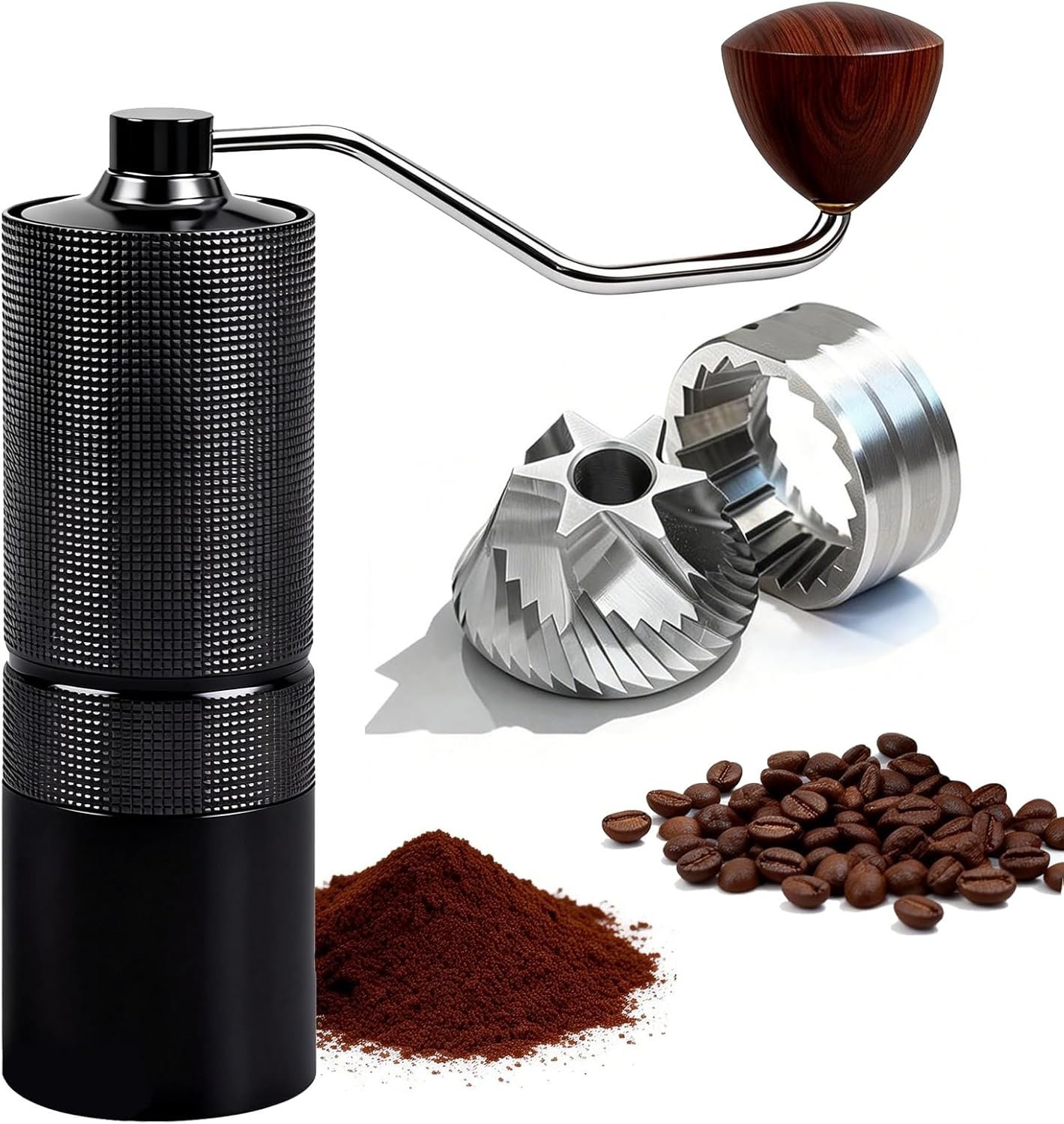
Expert Rating: 4.6/5 Stars | Est. Price Bracket: $29.99
The integrity of coffee extraction begins with the grind. A manual grinder must deliver precision, consistency, and durability to warrant its place in a serious coffee enthusiast’s kit. The Hamiladuo Manual Coffee Grinder presents a technically focused design, promising uniform particle distribution critical for optimal flavor clarity across diverse brew methods.
Technical Breakdown
- Burr Geometry: Features an upgraded hexagonal conical burr, a deliberate engineering choice over common pentagonal designs. This geometry is specifically optimized for efficient cutting and producing a more consistent particle size, particularly beneficial for the fine tolerances required by espresso while also expediting grinding for pour-over applications.
- Material Science: The burr itself is precision CNC-machined stainless steel, boasting a hardness rating of 55-58 HRC, ensuring exceptional cutting efficacy and long-term edge retention. The grinder’s body is constructed from full-metal aluminum alloy, providing robust structural integrity, superior durability, and efficient thermal dissipation to prevent heat transfer to the beans during intensive grinding.
- Concentricity & Stability: A dual-bearing central shaft design is integrated to maintain strict concentricity between the inner and outer burrs. This critical mechanical feature minimizes shaft wobble, which is paramount for achieving a uniform grind profile devoid of excessive fines or boulders, thus ensuring predictable and balanced extraction.
- Grind Adjustability: An intuitive, built-in grind adjustment mechanism allows the user to precisely calibrate the grind setting. While the exact number of steps is not specified, the system is designed to provide distinct changes for adapting from espresso fineness to French Press coarseness.
The Real-wold Performance
The hexagonal burr, combined with the dual-bearing stabilization, translates directly into a superior cup. This system consistently produces a tight particle distribution, resulting in a more uniform extraction. For espresso, this means fewer channeling issues, a richer, more defined crema, and a balanced flavor profile free from the harshness of over-extracted fines or the sourness of under-extracted boulders. For pour-over or immersion methods, the clarity and sweetness are notably enhanced due to the even extraction. The aluminum alloy body’s thermal properties are particularly beneficial, preventing heat buildup during grinding that could compromise the delicate volatile aromatics of the coffee, thereby preserving the bean’s inherent flavor integrity.
Who is this for?
This grinder targets the discerning coffee aficionado or traveler demanding consistent, high-precision grinding for both espresso and filter applications in a durable, portable form factor.
Data Breakdown
| Specification | Detail |
|---|---|
| Burr Type | Hexagonal Conical |
| Burr Material | CNC Stainless Steel |
| Body Material | Full Metal Aluminum Alloy |
| Burr Hardness | 55-58 HRC |
| Bearing System | Dual Bearing Central Shaft |
| Capacity (Beans) | 20g |
The Good:
- Upgraded hexagonal CNC stainless steel burrs (55-58 HRC) for superior cutting and edge retention.
- Dual-bearing central shaft design ensures excellent burr concentricity and grind consistency.
- Full-metal aluminum alloy body offers robust durability and efficient heat dissipation.
- Produces tight particle distribution, resulting in superior espresso and pour-over quality.
- Intuitive grind adjustment for a wide range of brew methods.
The Trade-offs (Cons):
- The exact number of grind adjustment steps is not specified, which can be a minor limitation for micro-adjustments.
- 20g bean capacity is suitable for single servings, but may require multiple refills for larger batches.
3. On The Go 135 Manual Coffee Grinder
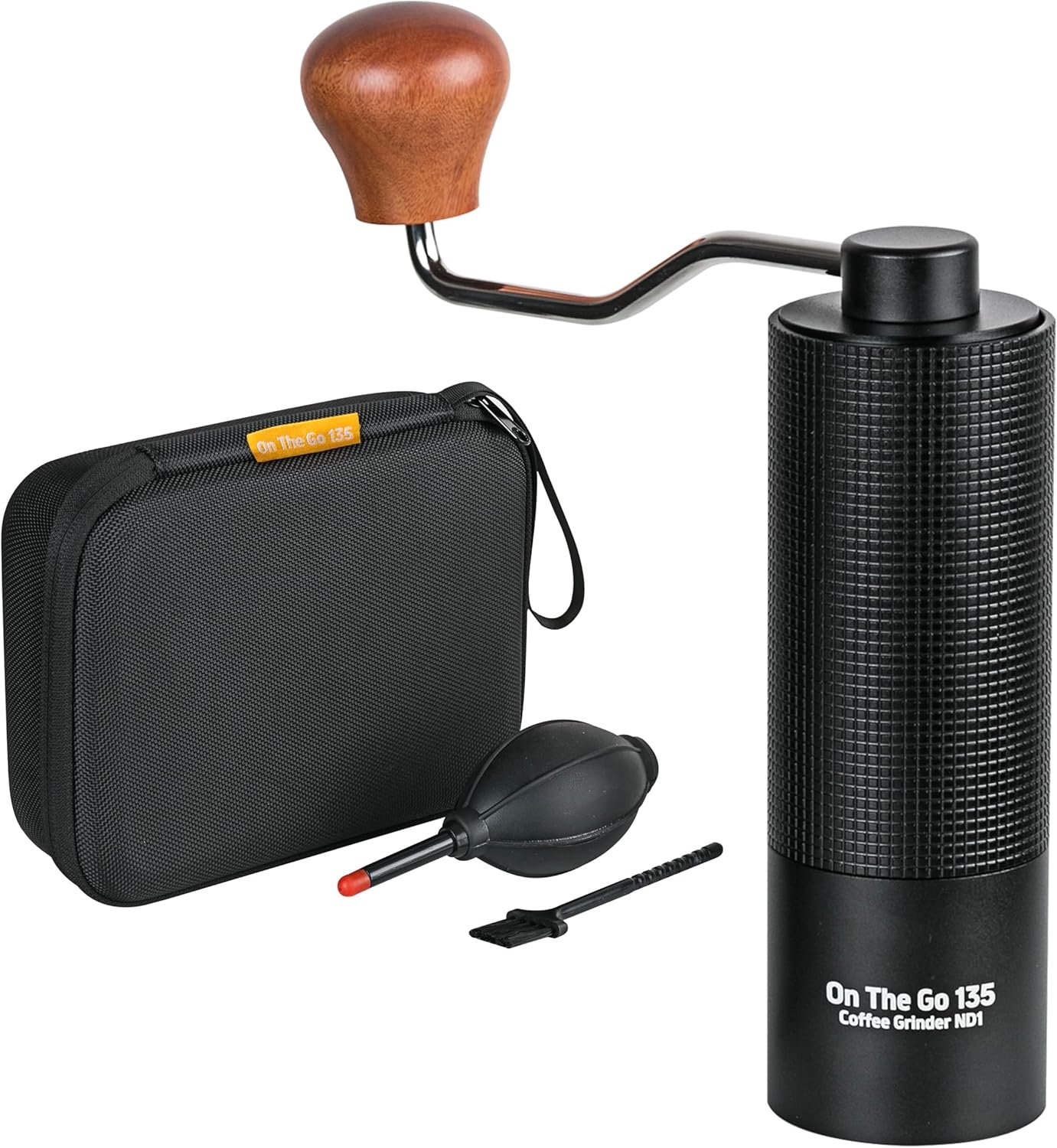
Expert Rating: 4.9/5 Stars | Est. Price Bracket: $34.62
As a meticulous professional, I understand the critical role precise grind consistency plays in extracting optimal flavor. The On The Go 135 presents itself as a compact solution for the discerning traveler, promising uncompromising quality in a highly portable package. Let’s delve into its technical merits and practical performance for the serious coffee enthusiast.
Technical Breakdown
- Burr Mechanism: This unit employs a precision-cut stainless steel conical burr. The intrinsic geometry of a conical burr, especially when crafted from stainless steel, is crucial for producing a consistent particle distribution, minimizing fines, and preserving the nuanced aromatics of the bean by reducing heat transfer during grinding.
- Bearing System: The shaft incorporates a double bearing system. This engineering detail is paramount for maintaining absolute concentricity of the burr set, which directly translates to superior grind uniformity across all settings—a non-negotiable for consistent extraction, particularly at espresso fineness.
- Adjustment Mechanism: An adjustable grind setting system facilitates a spectrum of particle sizes, accommodating methods from espresso and Moka Pot to pour-over, Aeropress, and French Press. While the exact incrementality is unspecified, its capability to traverse such a range indicates a robust internal mechanism.
- Construction & Ergonomics: The grinder features a durable aluminum-alloy body, offering a secure, substantial grip. This metal construction, coupled with an ergonomic design, ensures a stable platform and smooth cranking experience, reducing effort and potential for inconsistencies during the grinding process.
- Portability & Accessories: The inclusion of a shock-proof EVA hard case and a long-nozzle air blower elevates its utility. The case protects the intricate burr assembly from transit damage, while the blower is critical for thorough cleaning, preventing retention of stale grounds and ensuring optimal performance and longevity of the burrs.
The Real-world Performance
The On The Go 135’s uniform grind consistency, attributable to its precision stainless steel burr and double bearing system, is foundational for superior extraction. For espresso applications, this consistency directly translates to a more even flow rate, facilitating a richer, more stable crema and preventing channeling. For pour-overs and French Press, the minimized fines result in a cleaner cup profile, free from undesirable bitterness or astringency. Furthermore, the manual nature of the grinder inherently generates minimal heat, thus preserving the delicate aromatic compounds and volatile oils critical to the coffee’s natural flavor, ensuring temperature stability is not a variable in extraction quality.
Who is this for?
This grinder is engineered for the meticulous coffee enthusiast demanding consistent, high-quality grinds for travel, camping, or a minimalist home setup.
Data Breakdown
| Specification | Detail |
|---|---|
| Burr Material | Stainless Steel Conical |
| Body Material | Aluminum-Alloy |
| Max Capacity | 0.88 oz (approx. 25g) |
| Grind Adjustment | Adjustable, Espresso to French Press |
| Bearing System | Double Bearing |
| Included Accessories | EVA Hard Case, Air Blower |
The Good:
- Precision-cut stainless steel conical burrs for consistent grind quality.
- Double bearing system ensures superior burr concentricity and grind uniformity.
- Durable aluminum-alloy body with ergonomic design for stable grinding.
- Wide range of adjustable grind settings, suitable for espresso to French Press.
- Includes valuable accessories: shock-proof EVA hard case and air blower for maintenance.
The Trade-offs (Cons):
- Exact incrementality of grind adjustment steps is not specified, which might hinder ultra-fine tuning.
- 25g capacity is best suited for single or double servings, requiring refills for larger brews.
4. Hario Mini-Slim Plus
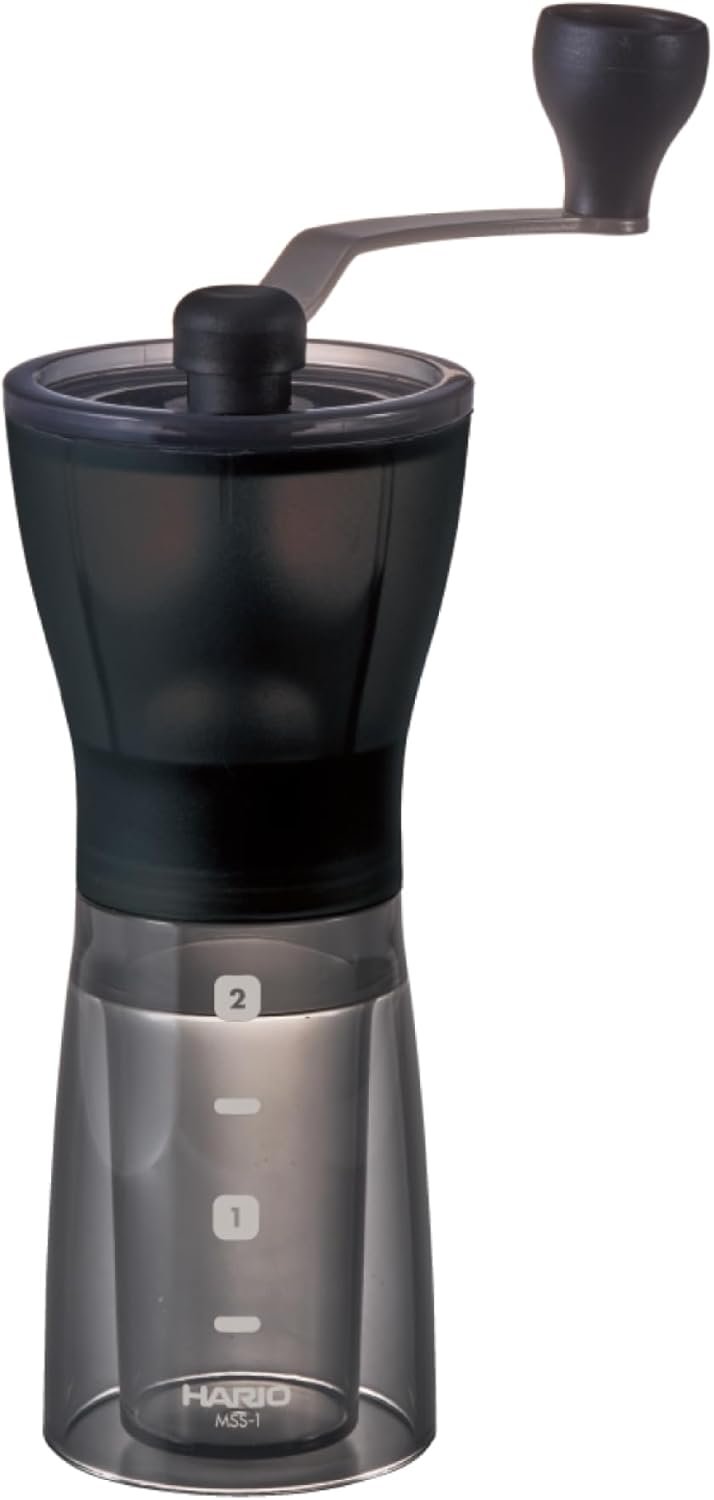
Expert Rating: 4.5/5 Stars | Est. Price Bracket: $26.99
The Hario Mini-Slim Plus presents itself as a compact, utilitarian hand grinder, often lauded for its portability and consistent output. For the discerning coffee enthusiast, the foundation of any exceptional brew lies in uniform particle distribution, and this device aims to deliver just that, even on the go.
Technical Breakdown
- Ceramic Conical Burrs: The core of its performance lies in the ceramic conical burr set. Unlike metal burrs, ceramic minimizes heat transfer during grinding, preventing premature degradation of delicate aromatics. The conical design effectively shaves coffee beans into uniform particles, a superior method to the impact-based pulverization of blade grinders, ensuring a more consistent particle size distribution critical for optimal extraction.
- Grind Coarseness Adjustment: An intuitive click-stop mechanism located beneath the burr set allows for precise, repeatable adjustments across a spectrum of grind sizes. This system ensures consistent coarseness settings are easily recalled, crucial for optimizing extraction for various brewing methods, from pour-over to French press.
- Ergonomic Redesign: Hario has refined the original Mini-Slim with an upgraded ergonomic handle and a reinforced shaft coupling. This enhancement significantly improves rotational stability and power transfer during grinding, reducing slippage and ensuring a smoother, more efficient grinding experience without compromising torque.
- Compact Design & Capacity: Engineered for both countertop utility and travel, its slim profile and detachable handle optimize storage efficiency. With a 24-gram capacity, it adequately services a single pour-over or a small batch of French press, striking a balance between portability and practical volume.
The Real-world Performance
In practical application, the Mini-Slim Plus consistently delivers a respectable grind distribution across its finer and medium settings, crucial for a clean extraction in methods like pour-over or AeroPress. The ceramic burrs’ inherent low heat transfer capability safeguards the volatile compounds within the coffee, resulting in a cup profile that maintains integrity and nuanced flavor. While achieving a true espresso-grade consistency demands a higher-tier grinder, this unit produces sufficient fines and uniform particles at its finer settings to facilitate a decent brew with an espresso machine in a pinch, though extraction flow rates may require careful attention. For coarser grinds, consistency slightly diminishes, but remains acceptable for French press, yielding a cup with minimal sludge and robust flavor.
Who is this for?
This grinder is ideal for the meticulous traveler or minimalist home brewer prioritizing consistent single-serve to double-serve manual brewing.
Data Breakdown
| Specification | Detail |
|---|---|
| Coffee Capacity | 24 grams |
| Burr Type | Ceramic Conical |
| Grind Adjustment | Click-stop mechanism |
| Dimensions (WxDxH) | 150 × 72 × 220 mm |
| Handle Design | Detachable Ergonomic |
| Origin | Designed by Hario in Japan |
The Good:
- Ceramic conical burrs minimize heat transfer, preserving coffee aromatics.
- Click-stop adjustment mechanism allows for precise and repeatable settings.
- Upgraded ergonomic handle and reinforced shaft for improved stability and efficiency.
- Compact design with detachable handle, ideal for travel and storage.
- Delivers respectable grind consistency for pour-over and AeroPress.
The Trade-offs (Cons):
- Espresso-grade consistency requires careful attention and is not its strongest suit.
- Grind consistency slightly diminishes at coarser settings (e.g., French Press).
- Ceramic burrs can be more fragile than steel against foreign objects.
5. COLETTI Crag
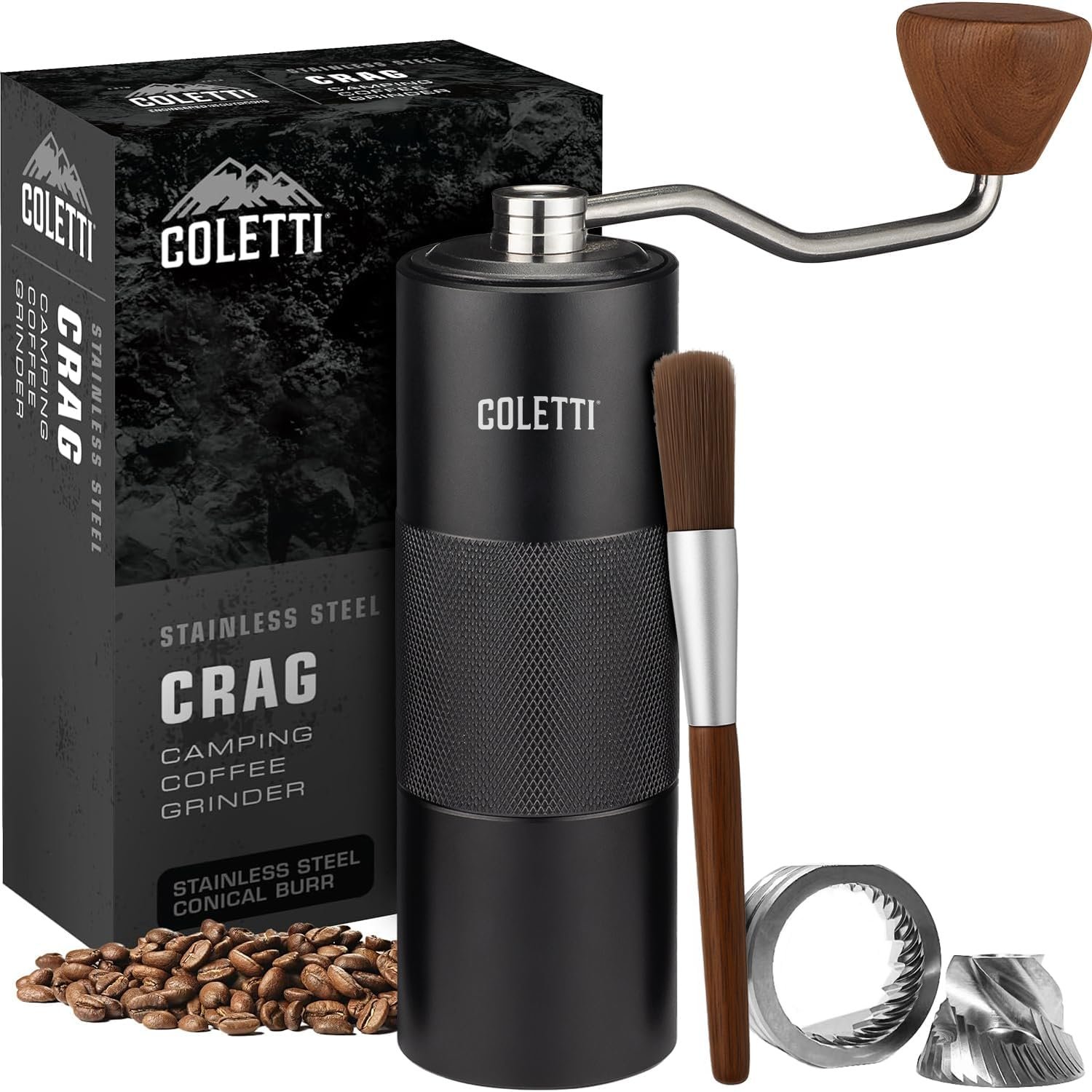
Expert Rating: 4.5/5 Stars | Est. Price Bracket: $44.39
The manual coffee grinder market is saturated with options promising precision and durability. The COLETTI Crag steps into this competitive arena, positioning itself as a robust solution for enthusiasts who demand consistent particle distribution on the go, without sacrificing grind quality.
Technical Breakdown
- Grind Mechanism: The claim of “CNC Burr Precision” suggests manufacturing tolerances designed for minimal burr wobble, critical for uniform particle size distribution across the grind range. This directly impacts extraction consistency and mitigates fines production.
- Adjustment System: The intuitive control dial offers stepped adjustments, enabling rapid transitions between particle sizes suitable for espresso, pour-over, or French press. The granularity of adjustment, however, is a key consideration for dialing in specific brew methods where micro-adjustments are paramount.
- Construction Material: While specific material composition isn’t detailed beyond “heavy duty” and “rugged build quality,” it implies robust metal construction, crucial for resistance to impact and wear during travel. The BPA-free designation ensures material inertness, preventing flavor taint.
- Portability & Ergonomics: The detachable handle and compact form factor are deliberate design choices for minimizing packed volume. This caters specifically to adventure and travel scenarios where space is at a premium, without compromising grinding leverage.
- Maintenance Protocol: The dishwasher-safe and quick-breakdown design addresses a common pain point: grinder upkeep. Ease of cleaning prevents rancid oil buildup and cross-contamination of bean profiles, maintaining grind integrity and optimal flavor.
The Real-world Performance
In practical application, the Crag delivers a notably consistent grind, particularly within the medium to coarse spectrum. This uniformity is paramount for a balanced extraction, mitigating channeling in pour-overs and reducing sludge in French presses, which directly translates to improved flavor clarity and sweetness. For espresso, while it can achieve sufficient fineness, precise micro-adjustments for dialing in shot times are where its stepped system shows limitations, potentially affecting crema formation and thermal stability during extraction due to subtle flow variations.
Who is this for?
This grinder is ideal for the discerning traveler or outdoor enthusiast prioritizing durable construction and consistent grind quality for filter methods or a robust espresso where ultimate micro-adjustability is not the primary concern.
Data Breakdown
| Specification | Detail |
|---|---|
| Grind Mechanism | CNC Precision Burrs |
| Coarseness Adjustment | External Control Dial (Stepped) |
| Cleaning | Dishwasher Safe, Quick Disassembly |
| Portability Features | Detachable Handle, Compact Design |
| Material Compliance | BPA-Free Components |
| Warranty | Lifetime Replacement Program |
The Good:
- CNC precision burrs provide uniform particle distribution.
- Rugged, heavy-duty build quality for exceptional durability.
- Dishwasher-safe components and quick disassembly for easy cleaning.
- Highly portable with a detachable handle and compact design.
- Good consistency for medium to coarse grinds.
- Comes with a lifetime replacement program.
The Trade-offs (Cons):
- Stepped adjustment system limits micro-adjustments crucial for precise espresso dialing.
- Specific burr material composition not explicitly detailed beyond “CNC Precision Burrs.”
- Less ideal for ultimate espresso precision compared to grinders with stepless or finer-stepped adjustments.
Summary Verdict: Top Picks Compared
| Image | Product | Rating & Price | Action |
|---|---|---|---|
|
Manual Coffee Grinder | 4.8 Stars $24.99 |
Check Price |
|
Hamiladuo Manual Coffee Grinder | 4.6 Stars $29.99 |
Check Price |
|
On The Go 135 Manual Coffee Grinder | 4.9 Stars $34.62 |
Check Price |
|
Hario Mini-Slim Plus | 4.5 Stars $26.99 |
Check Price |
|
COLETTI Crag | 4.5 Stars $44.39 |
Check Price |
Essential Technical Factors for Sub-$50 Manual Grinders
Navigating the manual grinder market under the $50 threshold demands an understanding of a few critical technical parameters that directly impact your final brew. While premium features are often out of reach, astute evaluation of these basics can still yield a highly capable device for espresso and other methods.
1. Burr Material and Geometry: The burrs are the heart of any grinder. For this price point, you’ll typically encounter stainless steel or ceramic conical burrs. Stainless steel burrs, especially those precision CNC-machined, offer superior cutting ability and durability compared to lesser alloys, leading to a more uniform grind. Look for specifications like HRC (Rockwell hardness scale) if provided, as higher values (e.g., 55-58 HRC) indicate better edge retention. Ceramic burrs, while less prone to static and heat generation, can be more brittle. Crucially, the geometry of the burr (e.g., hexagonal versus pentagonal) influences cutting efficiency and particle size consistency. A well-designed conical burr system minimizes “fines”—tiny dust-like particles that cause bitterness—and “boulders”—large chunks that lead to sourness—both of which compromise espresso extraction.
2. Bearing System and Grind Adjustment Mechanism: Burr wobble is the arch-nemesis of grind consistency. A robust bearing system, ideally a dual-bearing central shaft, is paramount. This minimizes lateral movement of the inner burr, maintaining precise alignment with the outer burr, and thereby ensuring a consistent gap for uniform particle output. For grind adjustment, look for a mechanism that offers a sufficient number of distinct steps or, ideally, micro-adjustments if espresso is your primary focus. A system with fewer than 10-15 steps will struggle to dial in espresso precisely, often forcing compromises in flow rate and flavor balance. A click-stop mechanism is preferable for repeatability. The combination of stable burr alignment and granular adjustment is what allows you to fine-tune your grind for optimal extraction, transforming decent beans into extraordinary coffee, even with a budget-friendly manual grinder.
