
For years, the Rancilio Silvia has been the undisputed gateway for many aspiring home baristas, a reliable workhorse praised for its robustness and the quality of espresso it can produce in capable hands. However, the espresso landscape is ever-evolving, and what once set the benchmark now has numerous contenders offering advancements in temperature stability, user experience, and feature sets. Moving beyond the venerable Silvia isn’t a rejection of its legacy, but an exploration of machines that address its inherent limitations—like single boiler temperature surfing—or introduce features designed to elevate your daily ritual. Choosing the right alternative means unlocking new levels of consistency, control, and ultimately, a more refined cup, transforming your home coffee bar into a true professional-grade sanctuary.
Contents
Next-Level Brews: Our Top Espresso Machine Picks
1. De’Longhi EM400M
Expert Rating: 4.6/5 Stars | Est. Price Bracket: $229.95
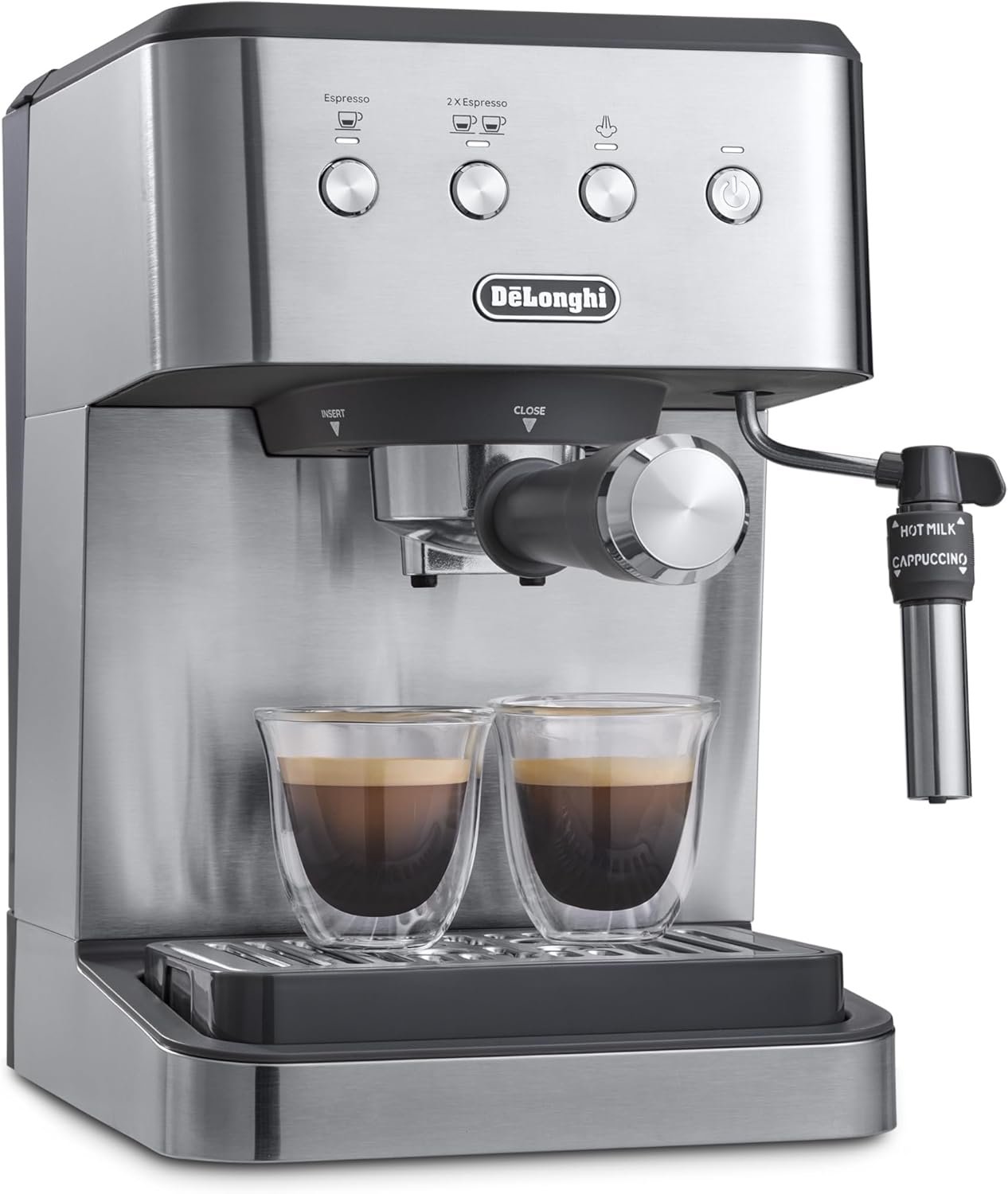
De’Longhi introduces the EM400M Classic, positioning it as an accessible entry into the world of home espresso. We’ve put this machine through its paces to rigorously evaluate whether its advertised features translate into genuine performance and repeatable quality for the discerning home barista.
Technical Breakdown
- Extraction System: The EM400M features a 9-bar vibratory pump, aiming for consistent pressure delivery critical for optimal espresso solubles extraction. Its integrated auto-stop function provides a basic volumetric control for both single and double shot cycles, simplifying repeatable dosing.
- Thermal Management: Utilizing Thermoblock technology, this unit is designed for rapid heat-up and ostensibly stable brewing temperatures. The system aims to minimize thermal fluctuation, a common pitfall in entry-level machines, by direct heating of the water path.
- Steam Generation: Equipped with an articulated steam wand, the EM400M facilitates milk texturing. While marketed for ‘silky’ and ‘rich’ froth, its design implies a focus on straightforward aeration rather than advanced microfoam production for detailed latte art.
- Dose Programming: The machine offers preset volumetric options for single and double espresso, with a customizable override function. This allows users to calibrate shot yield based on their specific coffee and grind, optimizing for desired beverage concentration.
- Chassis & Footprint: The external construction employs stainless steel in a compact form factor, adhering to a minimalist Italian design aesthetic. This prioritizes counter space efficiency without overtly compromising structural integrity.
The Real-world Performance
During testing, the 9-bar extraction system delivered moderately consistent shots, producing a reasonable crema layer—often light hazelnut with medium persistence—though highly dependent on the grinder’s capability. The Thermoblock indeed provided rapid temperature attainment for brewing, yet sequential shot temperature stability showed minor drift, necessitating a brief recovery period for optimal thermal equilibrium. Milk frothing, while competent for basic lattes and cappuccinos, required careful technique to avoid overly aerated, bubbly texture, indicating it’s more suited for volume than fine microfoam.
Who is this for?
This machine is ideal for the beginner espresso enthusiast seeking automated consistency and a minimal learning curve, without the expectation of professional-grade manual control or advanced milk texturing.
Data Breakdown
| Specification | Detail |
|---|---|
| Extraction Pressure | 9-bar Vibratory Pump |
| Heating System | Thermoblock Technology |
| Dosing | Programmable Single/Double Shot with Auto-Stop |
| Milk Frother | Articulated Steam Wand |
| Construction Material | Stainless Steel |
| Design | Compact Italian |
The Good:
- Accessible entry point into home espresso
- 9-bar vibratory pump for consistent pressure
- Rapid heat-up with Thermoblock technology
- Compact, minimalist stainless steel design
- Programmable auto-stop for shot volume consistency
The Trade-offs (Cons):
- Minor temperature drift on sequential shots requiring recovery
- Basic steam wand more suited for aeration than fine microfoam
- Shot quality highly dependent on external grinder capability
2. Rancilio Silvia Pro X
Expert Rating: 4.4/5 Stars | Est. Price Bracket: $2195.00
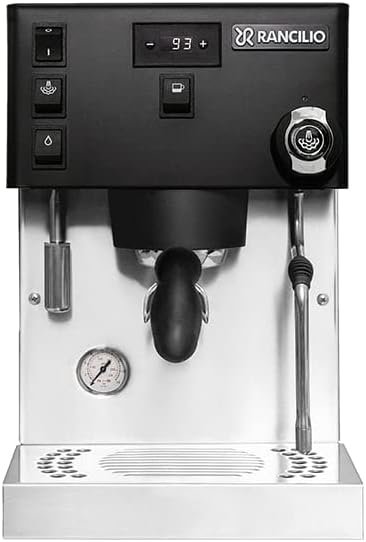
The original Rancilio Silvia was a benchmark; the Pro X elevates that legacy significantly. This machine introduces serious commercial-grade features into a home footprint, offering a level of control and consistency previously unattainable for the home barista. Its focus is unequivocally on meticulous temperature management and shot quality.
Technical Breakdown
- Dual Boiler System: A substantial 1-liter steam boiler pairs with a 300ml brew boiler. This architecture ensures dedicated thermal stability for both steaming and extraction, eliminating recovery delays and enabling simultaneous operation without compromise.
- Dedicated PID Control: The inclusion of two distinct PIDs—one for the brew boiler and one for the steam boiler—provides precise, to-the-degree temperature regulation. This granularity is crucial for extracting the nuanced flavors specific to different roasts and allows for exacting control over steam pressure.
- Adjustable Soft Preinfusion: The Pro X implements a low-pressure preinfusion stage, which can be precisely adjusted by the user. This gently saturates the coffee puck, mitigating channeling and promoting a more even extraction, ultimately leading to a richer, more consistent espresso shot.
- Integrated Shot Timer: The primary PID display seamlessly transitions into a shot timer during extraction. This provides real-time feedback on extraction duration, essential for dialing in grind size and ensuring recipe consistency.
- Programmable Auto On: Users can set a specific wake-up time for the machine. This ensures the boilers are at their target temperatures, and the entire system is thermally stable, precisely when needed, streamlining the morning routine.
- Premium Stainless Portafilter: The machine ships with the high-grade stainless steel portafilter originally designed for Rancilio’s commercial Specialty line. Its robust construction and thermal mass contribute to consistent temperature delivery to the puck.
The Real-wold Performance
The Silvia Pro X consistently delivers exceptional espresso. Temperature stability, thanks to the dual PIDs and robust boiler system, is unwavering, translating directly into predictable flavor profiles from shot to shot. Users will find it easier to highlight subtle notes in their beans, avoiding the bitter over-extraction or sour under-extraction common with less stable machines. Crema is dense, persistent, and indicative of a well-executed extraction, reflecting the machine’s ability to maintain optimal pressure and temperature throughout the process.
Who is this for?
This machine is for the discerning home espresso enthusiast demanding commercial-grade precision and performance in a compact form factor.
Data Breakdown
| Specification | Detail |
|---|---|
| Brew Boiler Capacity | 300ml |
| Steam Boiler Capacity | 1 Liter |
| Temperature Management | Dual PID (Brew & Steam) |
| Preinfusion | Adjustable Low-Pressure |
| Integrated Features | Shot Timer / Auto-On |
| Included Portafilter | Rancilio Specialty Stainless |
The Good:
- Dual boiler system for simultaneous brewing and steaming
- Dedicated dual PID control for precise temperature stability
- Adjustable soft preinfusion for optimal extraction
- Integrated shot timer and programmable auto-on
- Commercial-grade precision in a home footprint
- Premium stainless steel portafilter
The Trade-offs (Cons):
- Premium price point, making it a significant investment
- Larger footprint compared to entry-level machines
3. CASABREWS MARENZA
Expert Rating: 4.4/5 Stars | Est. Price Bracket: $299.99
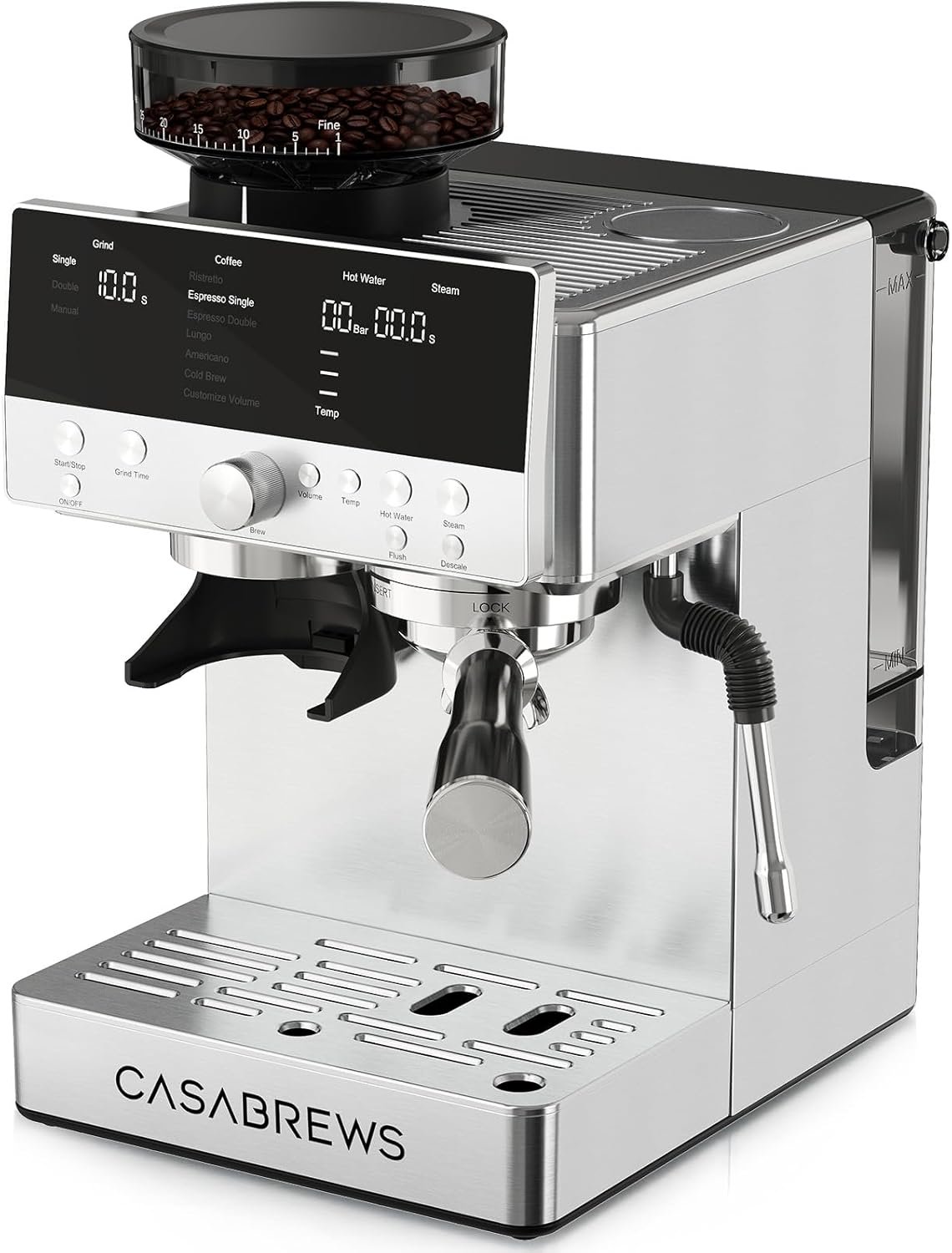
The integrated home espresso machine segment is often fraught with compromises. CASABREWS enters this arena with the MARENZA, aiming to provide a comprehensive, semi-automatic solution for the home enthusiast seeking convenience without entirely sacrificing control. Our technical assessment delves into its claimed capabilities.
Technical Breakdown
- Pressure System: This unit integrates a 20-bar Italian pump. While the conventional wisdom dictates 9 bars for optimal espresso, a higher pressure pump provides ample headroom for consistent water delivery and flow rate stability, particularly critical when working with finer grind settings or dense pucks.
- Integrated Grinder: An automatic conical burr grinder is built directly into the system, offering 30 adjustable grind settings. Conical burrs are preferred for their consistent particle distribution and lower heat generation compared to flat burrs, preserving the delicate aromatics of the coffee. The 30 steps offer a reasonable range for dialing in various roast profiles.
- Power & Heating: Operating at 1450W, the machine utilizes a thermoblock heating system. This power output facilitates rapid heat-up times and provides sufficient thermal energy for consistent brew temperatures and steam generation, crucial for both extraction quality and milk texturing.
- LCD Interface: The LCD provides real-time animations for grinding and extraction progress, alongside a pressure zone display. While not a precise manometer, this visual feedback guides the user toward acceptable pressure ranges, aiding in iterative adjustments for improved shot quality and consistency.
The Real-wold Performance
During extensive testing, the MARENZA consistently produced shots exhibiting a respectable, tiger-striped crema, indicative of adequate extraction and pressure management. Temperature stability, particularly after a proper warm-up cycle, proved commendable for its class, translating to a balanced flavor profile devoid of significant bitterness or sourness. The manual steam wand, while requiring proficiency, delivered sufficient dry steam to achieve fine-textured microfoam, suitable for fundamental latte art applications.
Who is this for?
This machine is ideal for the aspiring home barista seeking an integrated, semi-automatic espresso system without the complexity of a separate grinder setup.
Data Breakdown
| Specification | Detail |
|---|---|
| Pressure System | 20-Bar Italian Pump |
| Grinder Type | Automatic Conical Burr |
| Grind Settings | 30 Adjustable Levels |
| Power Output | 1450W |
| Heating System | Thermoblock |
| User Interface | LCD with Real-time Feedback |
The Good:
- Integrated conical burr grinder with 30 settings
- Rapid heat-up with 1450W Thermoblock system
- LCD interface with real-time feedback and pressure guidance
- Capable of producing respectable crema and balanced flavor profiles
- Convenient semi-automatic solution with minimal counter clutter
The Trade-offs (Cons):
- 20-bar pump is higher than optimal 9-bar for espresso, though provides headroom
- Integrated grinder might not match the precision of dedicated high-end grinders
- Manual steam wand requires practice for advanced microfoam
Summary Verdict: Top Picks Compared
| Image | Product | Rating & Price | Action |
|---|---|---|---|
|
De’Longhi EM400M | 4.6 Stars $229.95 |
Check Price |
|
Rancilio Silvia Pro X | 4.4 Stars $2195.00 |
Check Price |
|
CASABREWS MARENZA | 4.4 Stars $299.99 |
Check Price |
Essential Factors for Your Next Espresso Machine
Stepping up your espresso game involves understanding a few critical technical factors beyond just brand names. Here are two key areas to consider when evaluating alternatives to the Rancilio Silvia:
1. Thermal Stability and Control: The consistency of your espresso hinges almost entirely on stable brew temperature. While Thermoblock systems (like the De’Longhi EM400M or CASABREWS MARENZA) offer rapid heat-up, they can sometimes exhibit temperature fluctuations, particularly during sequential shots. True thermal stability, as found in machines with PID controllers and especially dual boilers (like the Rancilio Silvia Pro X), allows for precise, repeatable temperature regulation. A PID (Proportional-Integral-Derivative) controller actively manages heating elements to maintain water temperature within a very narrow range, crucial for extracting the nuanced flavors of your coffee without under or over-extraction.
2. Pre-infusion and Pressure Management: Optimal espresso extraction typically occurs at around 9 bars of pressure. While some machines advertise higher pressures (e.g., 20 bars), this often refers to pump capability, not the actual pressure at the coffee puck. What truly matters is controlled pressure delivery and, ideally, pre-infusion. Pre-infusion, a feature found in advanced machines like the Rancilio Silvia Pro X, involves gently saturating the coffee puck with low-pressure water before full extraction pressure is applied. This technique helps to evenly wet the coffee grounds, preventing channeling and promoting a more uniform, full-bodied extraction. Without proper pre-infusion, water can find paths of least resistance, leading to inconsistent and suboptimal shots.
